How to Appeal IRMAA After Retirement: SSA-44 Step-by-Step Guide
October 6, 2026
Download the original article PDF for the exact source layout and tables. Download the full guide (PDF)
Last updated October 6, 2026. Checked against Form SSA-44 (12-2025 edition), 20 CFR Part 418, Social Security's Program Operations Manual System (POMS), the 2025 IRS Form 1040, and CMS's 2026 premium figures. You can ask Social Security to lower IRMAA after you retire, but retirement alone doesn't do it.
Your 2026 premiums were set from your 2024 tax return, so a final working year can follow you into retirement. If you stopped working (a "work stoppage") or cut your hours (a "work reduction"), Form SSA-44 asks Social Security to use a more recent year's income. It works only if that newer MAGI is low enough to lower or remove your IRMAA.
You'll need the tax year on your notice, the right newer year, an honest MAGI estimate, and proof of the event.
The short version
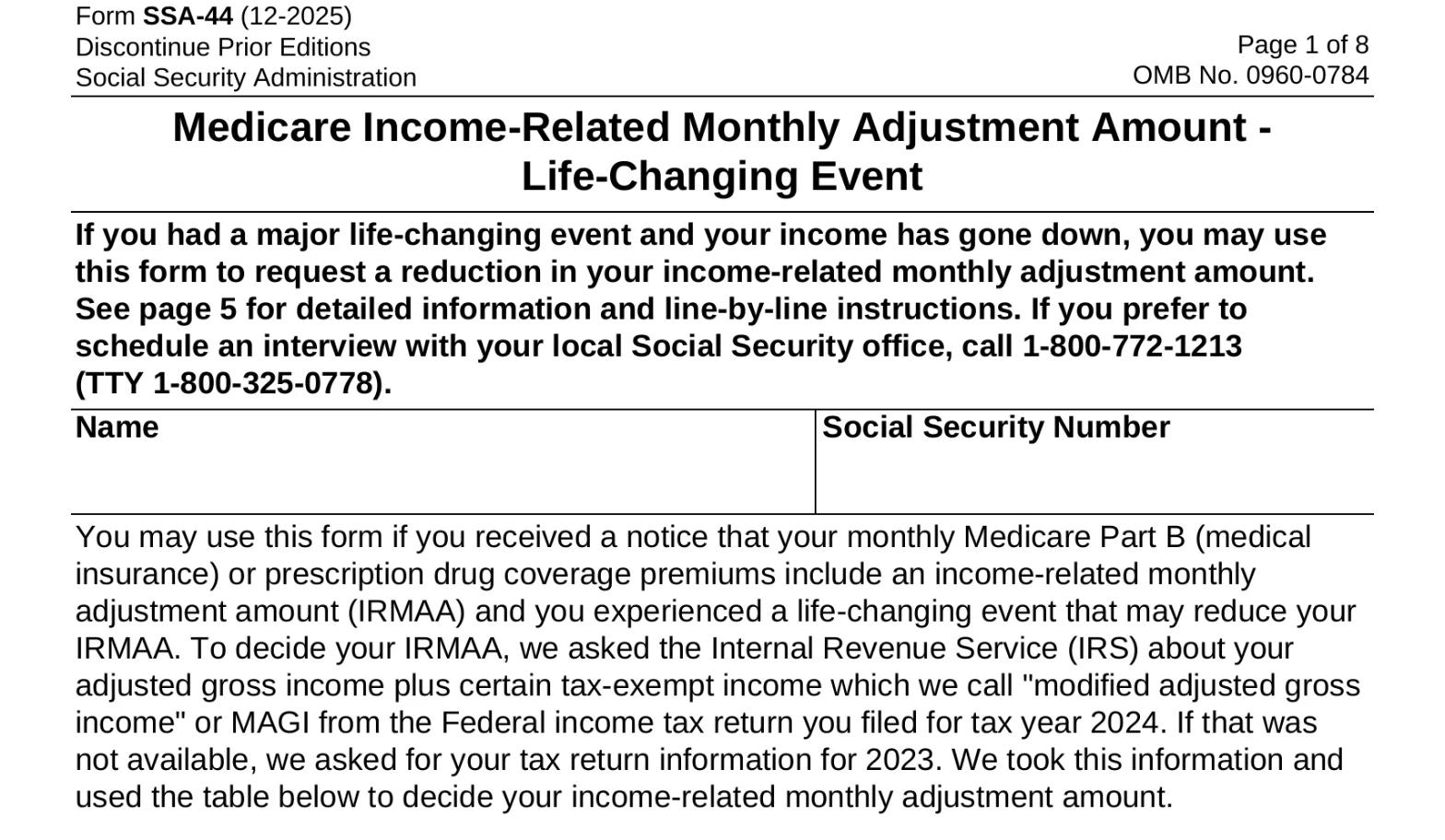
- The form: SSA-44, Medicare Income-Related Monthly Adjustment Amount – Life-Changing Event. It's optional; you can also make the request by phone or at an appointment.
- The box to check: Work Stoppage if you or your spouse stopped working, Work Reduction if hours were cut.
- What has to be true: your more recent modified adjusted gross income (MAGI) must drop enough to lower or eliminate your IRMAA.
- Timing: a favorable decision is generally effective January 1 of the year you make the request.
- Couples: each spouse who pays IRMAA files their own request. Official resource: Form SSA-44 comes only from Social Security, as a PDF on ssa.gov (current edition dated 12-2025) or online through the Request to lower IRMAA page. Before you fill anything in, find the tax year on your IRMAA notice and check whether your newer income actually crosses a bracket line; the sections below show how. Retired in 2026 and worried about 2027 IRMAA? Under the normal lookback, 2027 IRMAA will generally be based on your 2025 tax return. As of October 6, 2026, CMS had not published the official 2027 Part B premium or IRMAA brackets, and Medicare.gov still showed 2026 amounts, so don't plan around projections. The SSA-44 rules don't change: if your retirement lowers your MAGI enough to change your bracket, you can request a new determination. If you're already paying IRMAA in 2026, Step 3 of the form lets you report a lower expected 2027 MAGI on the same request.
On this page
- SSA-44 or SSA-561: which route do you need?
- Why are you still paying IRMAA after retirement?
- Does retirement qualify as a life-changing event?
- Which tax year should you put on SSA-44?
- How do you calculate MAGI for SSA-44?
- A worked example after a midyear retirement
- How to complete Form SSA-44, step by step
- What proof does Social Security accept?
- How do you submit SSA-44?
- What happens after Social Security reviews it?
- When SSA-44 is not the right route
- Common SSA-44 mistakes
- Frequently asked questions
SSA-44 or SSA-561: which route do you need?
Short answer: Form SSA-44 requests a new initial determination after a life-changing event; it isn't a formal appeal. The formal appeal is reconsideration on Form SSA-561-U2, within 60 days. If you qualify for a new determination, Social Security says you don't need to appeal, though you can file both within the appeal period (POMS HI 01120.001; POMS HI 01140.001).
| Your situation | Likely route |
|---|---|
| Retired or cut hours; newer MAGI lower | SSA-44: new initial determination |
| IRS reported incorrect figures | Ask IRS to correct records (1-800-829-1040); provide SSA proof |
| Amended return | Call SSA (1-800-772-1213) with amended return and IRS acknowledgment/transcript |
| Three-year-old return used; two-year-old return now filed | Ask SSA to use newer return; signed copy or transcript |
| Wrong bracket or miscalculation | SSA-561-U2 reconsideration within 60 days |
| Roth conversion, capital gain or property sale without qualifying event | Generally no SSA-44 route; non-qualifying events |
Sources: POMS HI 01120.001, HI 01120.005, HI 01140.005, and Social Security's Request to lower IRMAA page.
Why are you still paying IRMAA after retirement?
Short answer: Social Security normally uses your tax return from two years before the premium year. For 2026, that's your 2024 return, or 2023 if 2024 wasn't available. For a recent retiree, that return usually still shows a salary (Form SSA-44; POMS HI 01101.010). If you retired in the middle of 2025, the years line up like this:
| Premium year | Normal tax return | What it shows |
|---|---|---|
| 2026 | 2024 | Full year of salary |
| 2027 | 2025 | About six months of salary plus early retirement income |
| 2028 | 2026 | First full year of retirement income |
Two premium years can be priced off working income. Social Security isn't saying you still earn that much. It's using the only figure it has until you give it a better one.
What IRMAA adds to your premiums
IRMAA is charged per person, on top of the standard Part B premium ($202.90 a month in 2026) and your Part D plan's premium. The Part D portion goes to Medicare, not your plan (CMS 2026 fact sheet). On a joint return, the couple's combined MAGI is compared with the joint brackets, and each enrolled spouse pays the result.
The 2026 IRMAA brackets
| Individual MAGI | Joint MAGI | Part B IRMAA/month | Total Part B | Part D IRMAA/month |
|---|---|---|---|---|
| ≤ $109,000 | ≤ $218,000 | $0 | $202.90 | $0 |
| $109,000.01–$137,000 | $218,000.01–$274,000 | $81.20 | $284.10 | $14.50 |
| $137,000.01–$171,000 | $274,000.01–$342,000 | $202.90 | $405.80 | $37.50 |
| $171,000.01–$205,000 | $342,000.01–$410,000 | $324.60 | $527.50 | $60.40 |
| $205,000.01–$499,999.99 | $410,000.01–$749,999.99 | $446.30 | $649.20 | $83.30 |
| ≥ $500,000 | ≥ $750,000 | $487.00 | $689.90 | $91.00 |
Sources: Form SSA-44 (12-2025) and the CMS 2026 fact sheet. Married filing separately while living with your spouse at any point that year uses a steeper table: $446.30 (Part B) and $83.30 (Part D) from $109,000.01 to $390,999.99, and $487.00 and $91.00 above that.
Does retirement qualify as an IRMAA life-changing event?
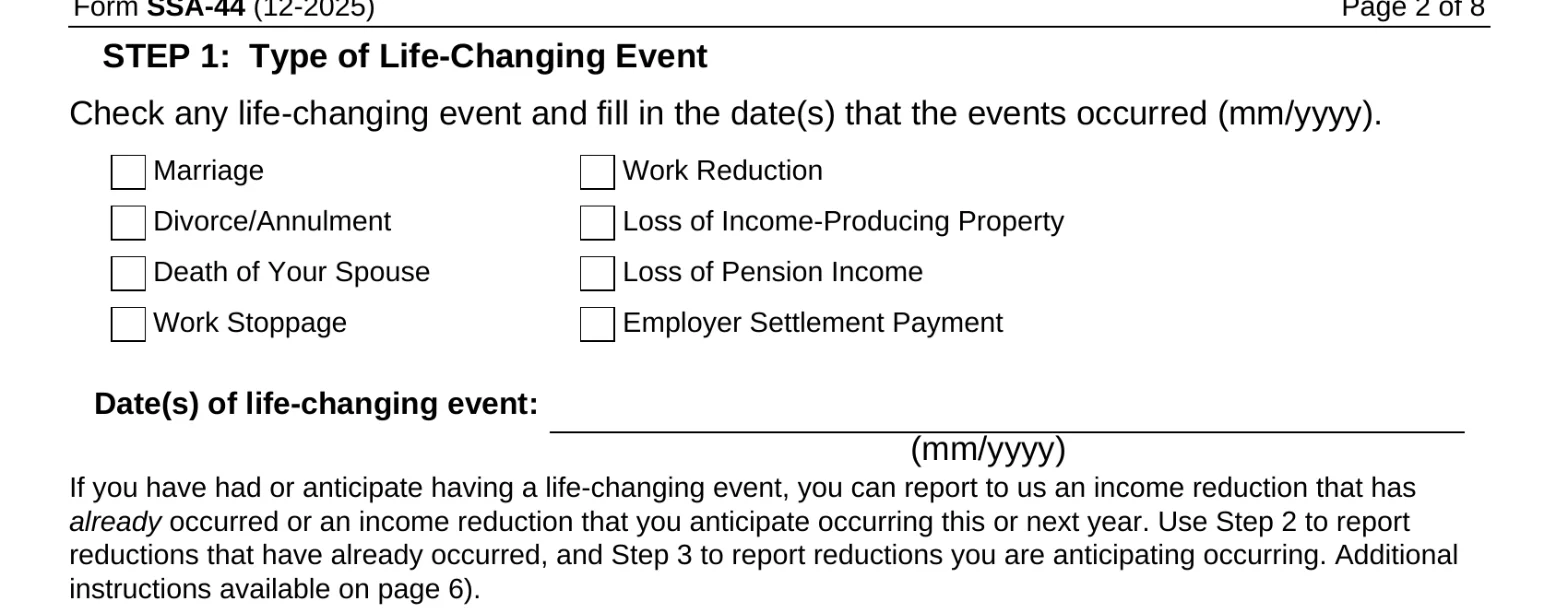
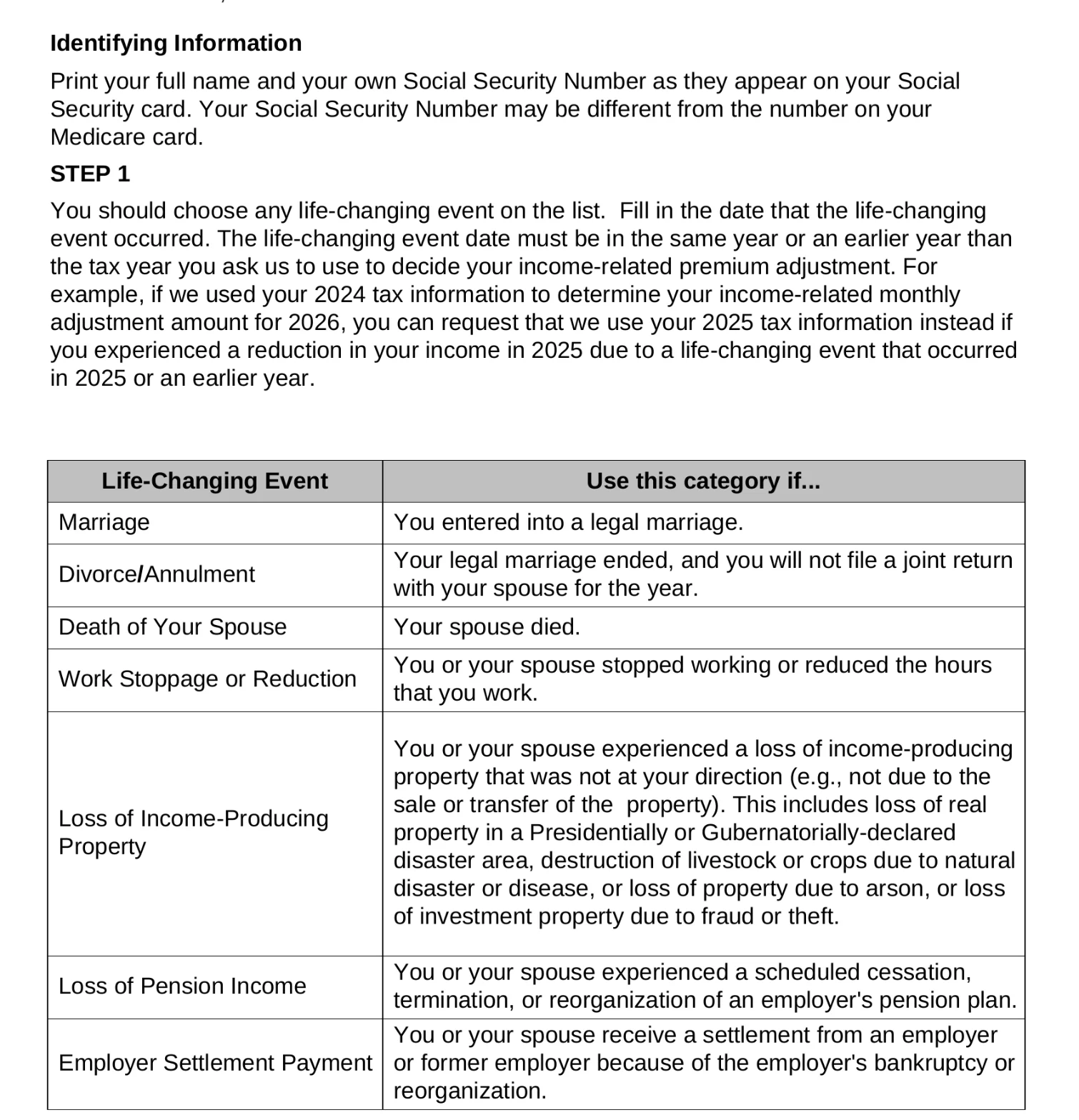
Short answer: Yes, as an event. Federal rules list "you or your spouse stop working or reduce the hours you work" as a major life-changing event (20 CFR 418.1205(d)). On SSA-44, retirement is Work Stoppage and cutting hours is Work Reduction. The event only helps if it causes a "significant" drop in MAGI, meaning one that lowers or eliminates your IRMAA (20 CFR 418.1215).
Social Security's manual lists retirement, a layoff, and the sale of a business as work stoppages, and partial retirement or a move to part-time work as work reductions (POMS HI 01120.030; HI 01120.025). Your spouse's retirement counts too.
Seven events or eight? The federal regulation lists seven major life-changing events, with stopping work and reducing hours in one category (20 CFR 418.1205). The instruction table above does the same. Step 1 of the form, though, shows Work Stoppage and Work Reduction as separate checkboxes, eight in all, and Social Security's manual lists them separately too (POMS HI 01120.005). Same rules, counted two ways.
The significance test is where most retirees' cases are decided. A single filer whose MAGI falls from $195,000 to $175,000 has had a real pay cut and a qualifying event, and nothing changes: both numbers sit in the same 2026 bracket.
| Statement | Meaning | Enough on its own? |
|---|---|---|
| I retired | You stopped working | No: event, not outcome |
| My income went down | Paycheck stopped | No: other income may replace salary |
| I had a life-changing event | On SSA’s list | Required, not sufficient |
| My MAGI is lower | AGI plus tax-exempt interest fell | Only if it changes your bracket |
| I qualify for a new determination | Event caused MAGI drop lowering/removing IRMAA | Yes: what SSA-44 asks SSA to act on |
Most retirees can answer the first three rows with confidence. The fourth is a number, and it's the one that decides the outcome. Not sure where your newer income falls? You can check your expected income against the current IRMAA brackets with the CheckIRMAA quiz before completing SSA-44.
What Social Security checks
You provide evidence of the event and of your more recent income, and you sign the request under penalty of perjury (20 CFR 418.1201; 418.1265). Social Security evaluates the qualifying event, the resulting reduction in MAGI, and the evidence you provide, and it may ask for more evidence if something is missing (POMS HI 01120.005; HI 01120.001). Your numbers are still checked.
Social Security compares what you report with IRS records, asks for your filed return once you file it, and adjusts your premium if the figures differ (20 CFR 418.1265(d)). The event also has to come first. Its date must fall in the same year as, or an earlier year than, the tax year you ask Social Security to use (SSA-44 instructions).
It can be years old, but a new determination can't take effect for a year before the event.
Which tax year should you put on SSA-44?
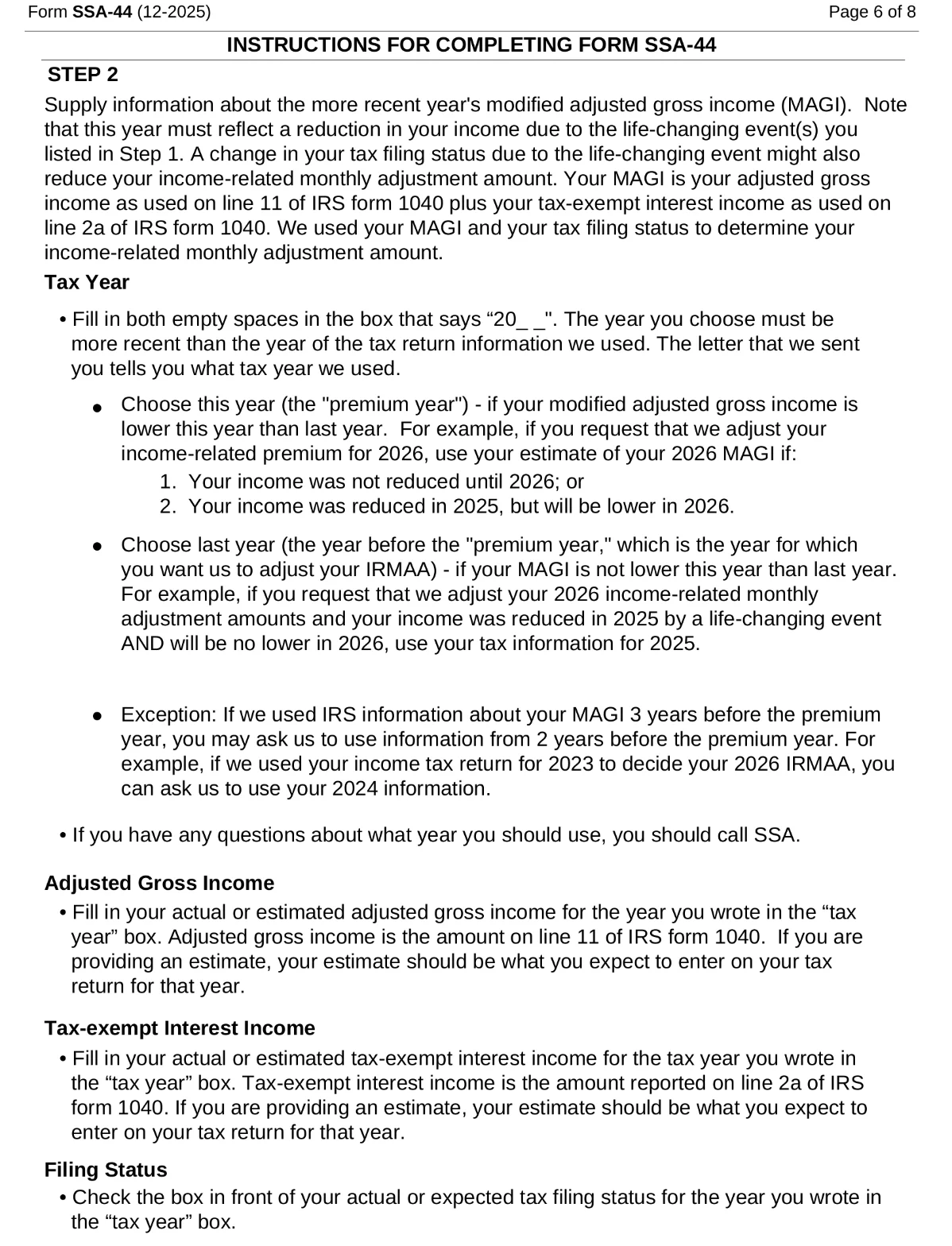
Short answer: A year more recent than the one on your IRMAA notice. Use the current year (the "premium year") if your MAGI this year will be lower than last year's; use last year if it won't be. For 2026 premiums, that means 2026 or 2025 (SSA-44 instructions; 20 CFR 418.1225).
| If | Step 2 year | 2026 example |
|---|---|---|
| Drop this year, or lower still this year | Current-year estimate | Retired June 2025; 2026 lower: enter 2026 |
| Drop last year; not lower this year | Last year | Retired January 2025; similar 2025/2026: enter 2025 |
| SSA used three-year-old return | Request two-year-old return | 2023 used for 2026: ask to use 2024 |
The rule turns on one comparison: will this year be lower than last year? A mid-2025 retiree's 2025 return still holds half a year of salary, so 2026 is usually the lower year. Unsure? The instructions say to call Social Security.
Watch out: if you retired late in a year, that year's return may still hold most of a salary. Entering it in Step 2 can leave your MAGI in the same bracket.
How do you calculate MAGI for SSA-44?
Short answer: IRMAA MAGI is your adjusted gross income (Form 1040, line 11) plus your tax-exempt interest (line 2a). On the redesigned 2025 Form 1040, AGI appears on line 11a and is repeated as line 11b on page 2 (POMS HI 01101.010; IRS 2025 Form 1040). IRMAA MAGI isn't taxable income.
The standard deduction, itemized deductions, and the new Schedule 1-A deductions, including the additional deduction for people 65 and older, are all subtracted after AGI. They lower your tax, not your IRMAA MAGI (IRS 2025 Form 1040; IRS Publication 6142). Retirement removes wages. These can keep MAGI high:
- Traditional IRA and workplace-plan withdrawals, including RMDs (lines 4b and 5b)
- Taxable pension and annuity income (line 5b) and the taxable part of Social Security (line 6b)
- Capital gains, including fund distributions (line 7a), plus dividends and taxable interest (lines 3b and 2b)
- Roth conversions, which Social Security lists as one-time income (POMS HI 01120.005)
- Net rental or business income (line 8)
- Municipal bond interest (line 2a), added back for IRMAA
- Final paychecks, bonuses, or vacation payouts received after you leave Qualified Roth IRA distributions are tax-free (IRS), and the untaxed part of Social Security stays out of AGI, so neither adds to IRMAA MAGI.
Making a good-faith estimate
If you're estimating the current year, SSA-44 asks for what you expect to report on that year's return. Build it from income you genuinely expect before December 31: scheduled pension and Social Security payments, planned IRA withdrawals and RMDs, expected fund distributions and realized gains, final compensation, and tax-exempt interest. Last year's 1099s and this year's statements are the best guide.
Watch out: you sign SSA-44 under penalty of perjury. Your estimate should reflect what you actually expect, not a number chosen to land under a bracket line. If it changes, tell Social Security (20 CFR 418.1245). Social Security later checks the estimate against IRS data, as explained in the after-review section below. The formula is simple.
What it means for you isn't clear until you see your estimate next to the line Social Security will measure it against.
Have your estimate? See what it means before it goes on SSA-44.
SSA-44 asks for the income you reasonably expect for the year. Before you enter it, CheckIRMAA can show you which IRMAA bracket that estimate falls in and whether it appears to cross a threshold compared with the income on your notice.
The quiz helps you understand the numbers. Social Security makes the actual determination.
A worked example: what SSA-44 can look like after a midyear retirement
Hypothetical example. Carol is invented, and her figures are illustrative. They don't predict how Social Security will decide any real request. Carol is single, 66, and enrolled in Part B and a Part D plan. She retired on June 30, 2025, from a job paying $175,000, and she's delaying Social Security.
She lives on IRA withdrawals and a taxable account that produces about $12,000 a year in dividends, interest, and fund distributions, plus $3,000 of municipal bond interest.
| Tax year | What happened | AGI | Tax-exempt interest | MAGI |
|---|---|---|---|---|
| 2024 | Full year of salary | $187,000 | $3,000 | $190,000 |
| 2025 | Six months salary ($87,500), $6,500 vacation payout, $9,000 IRA withdrawal | $115,000 | $3,000 | $118,000 |
| 2026 estimate | $54,000 IRA withdrawals; no wages | $66,000 | $3,000 | $69,000 |
What Social Security did. Carol's 2026 IRMAA uses her 2024 MAGI of $190,000, which falls in the $171,000.01 to $205,000 bracket: $324.60 a month for Part B plus $60.40 for Part D. That's $385 a month, or $4,620 for the year. What she enters. Step 1: Work Stoppage, 06/2025. Step 2: 2026, because her 2026 MAGI ($69,000) will be lower than her 2025 MAGI ($118,000).
Step 3: No, since she doesn't expect 2027 to be lower still. If Social Security accepts it. $69,000 is below the $109,000 threshold, so her 2026 IRMAA is eliminated, not just reduced. She had Part B all year, so the new determination is effective January 1, 2026, and Social Security refunds the excess she's paid since then (20 CFR 418.1230; POMS HI 01101.050).
If she waits until 2027. A request made in 2027 is generally effective January 1, 2027. Reaching back to the prior year is limited to events in October through December with a request by March 31, so a June retirement doesn't fit. Unless Social Security finds good cause for the late request, her 2026 surcharge would most likely stand (20 CFR 418.1310; POMS HI 01120.005).
And 2027? Left alone, 2027 would use her 2025 MAGI of $118,000. Under the regulations, Social Security keeps using the more recent year she provided until it receives IRS data for that year or a later one, or she updates it (20 CFR 418.1235). She should still check which income her 2027 notice uses.
Same retirement, different outcomes
Each of these hypothetical retirees had a 2024 MAGI of $190,000 ($380,000 for the couple), which put them in the same 2026 bracket: $385 a month per person. Each retired in mid-2025. Only their 2026 income differs.
| Hypothetical retiree | 2026 MAGI | Bracket | Monthly IRMAA B+D | Effect |
|---|---|---|---|---|
| A: modest IRA withdrawals | $69,000 | Below threshold | $0 | Eliminates IRMAA |
| B: extra IRA withdrawal to pay mortgage | $130,000 | $109,000.01–$137,000 | $95.70 | Reduces it; $7,000 below next bracket |
| C: joint; spouse still works | $245,000 joint | $218,000.01–$274,000 | $95.70 | Reduces for Medicare spouse |
| D: sells appreciated stock for house | $180,000 | $171,000.01–$205,000 | $385 | No bracket change |
All four stopped working, and all four had the same kind of life-changing event. Their outcomes changed because their MAGI landed in different places. The next question is where yours lands.
The missing number is yours
Carol and the other retirees above all stopped working. What decided their outcomes was where their newer MAGI landed. Your situation works the same way. Before you complete SSA-44, check where your expected income falls against the IRMAA thresholds. CheckIRMAA walks you through the relevant numbers so you can see whether your estimate appears to move you into a lower bracket, and how close it sits to the next line.
Check your estimate before you put it on SSA-44. CheckIRMAA doesn't determine whether Social Security will approve your request. It helps you understand the numbers behind it.
How to complete Form SSA-44 after retirement
This walkthrough follows the 12-2025 edition: the form on pages 1 to 3, a privacy statement on page 4, and instructions on pages 5 to 8. Keep your IRMAA notice and your most recent tax return beside you.
Page 1: name and Social Security number
Enter your name and your own Social Security number as they appear on your Social Security card. The instructions note that this number may differ from the one on your Medicare card. Page 1 also says that if your MAGI was at or below the first threshold, you don't owe IRMAA and shouldn't file.
Step 1: Type of life-changing event
- What you enter: Work Stoppage (or Work Reduction) and the month and year it happened. If your spouse's retirement is the event, use their date. Check every event that applies.
- Most likely mistake: a date later than the year you'll enter in Step 2.
Step 2: Reductions in income that have already occurred
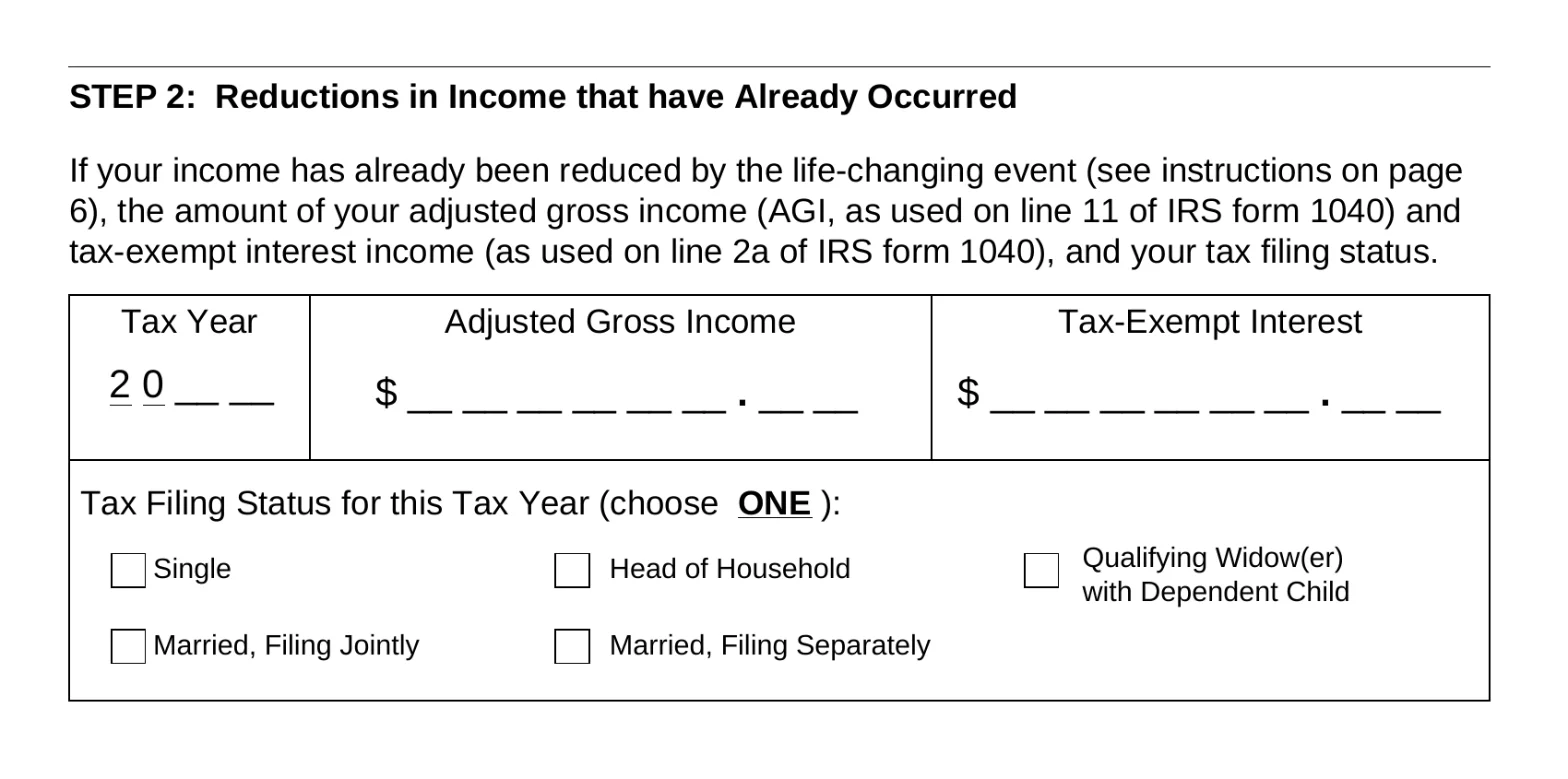
The heading is misleading. Despite "already occurred," the instructions let you enter a current-year estimate here. Read it as "your income has already dropped," even though the year isn't over.
- Tax year: chosen by the rule in the tax-year section above
- Adjusted gross income: line 11 of Form 1040 (line 11a on the 2025 form), actual or expected
- Tax-exempt interest: line 2a. Leave it blank by mistake and you understate your MAGI.
- Filing status: actual or expected for that year. For most retirees, it doesn't change.
- Most likely mistake: entering taxable income, or a late retirement year that still holds most of a salary. The form tells you which boxes to fill in. It can't tell you whether the estimate you're about to enter moves you into a lower bracket. Not sure? Check it with the CheckIRMAA quiz before you complete Step 2.
Step 3: Anticipated reductions in MAGI next year
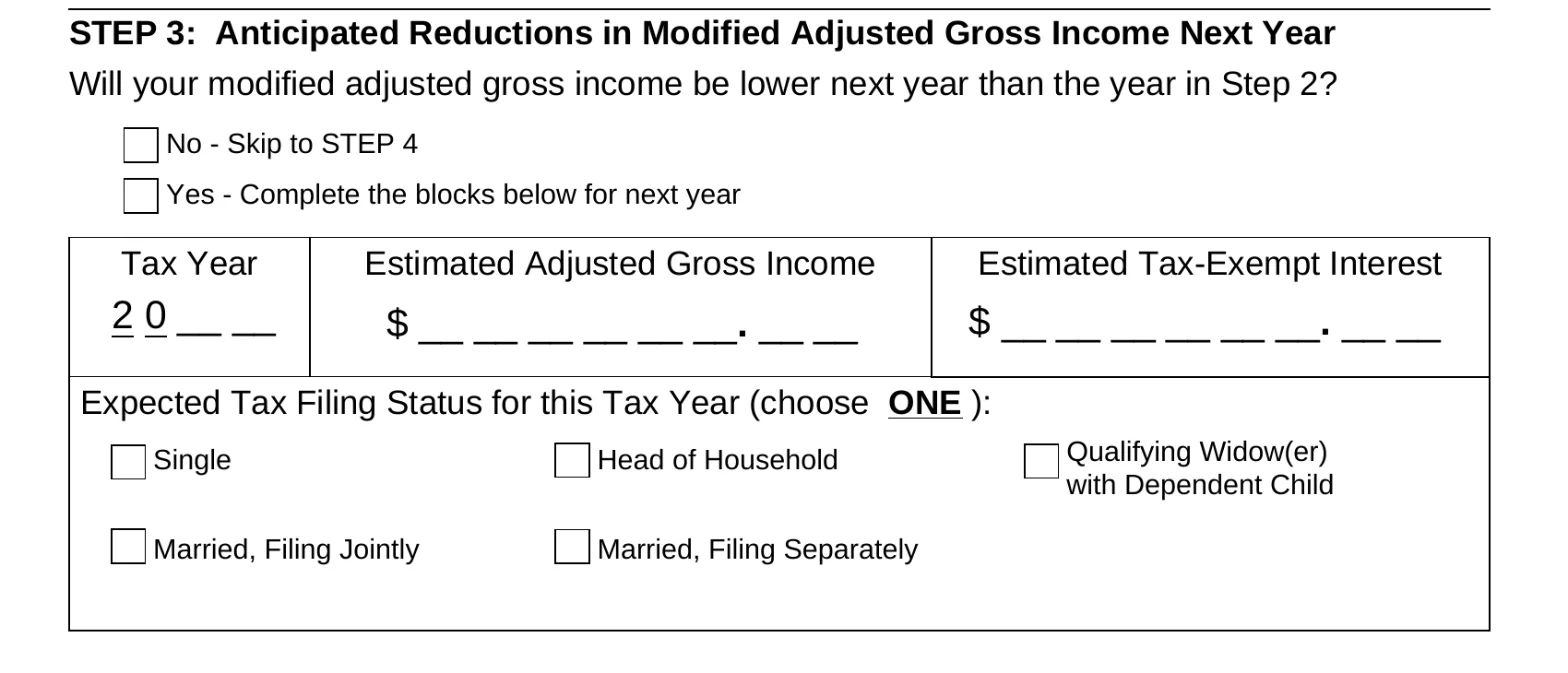
Answer "Yes" only if next year's MAGI will be lower still than the Step 2 year, and enter the following tax year. It matters most if you retire partway through the premium year: retire in June 2026, and your 2026 estimate still holds half a year of pay; your 2027 estimate won't. Starting Social Security or RMDs next year may raise MAGI instead.
Answer "No," and Social Security uses your Step 2 figures next year.
Step 4: Documentation
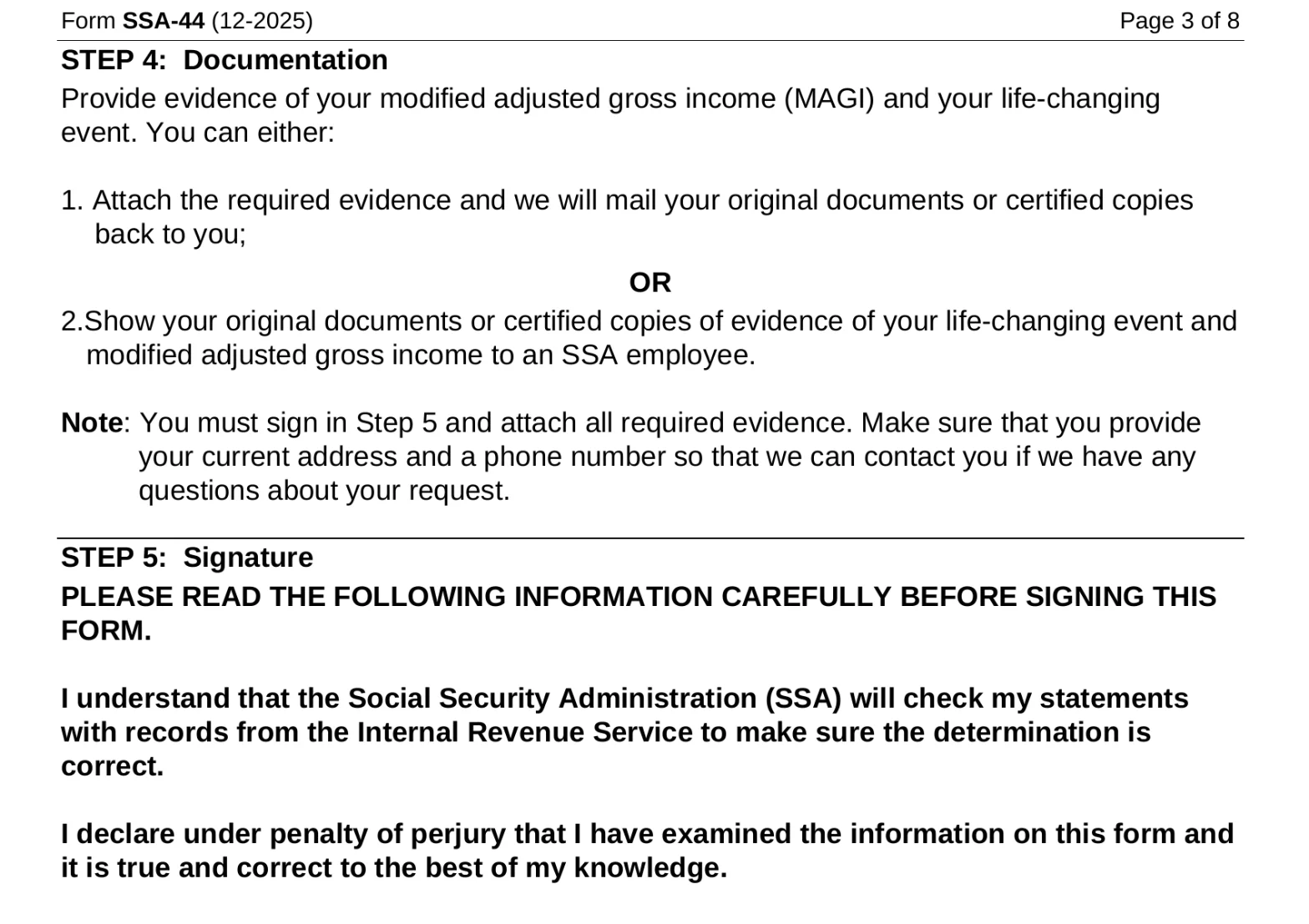
You need proof of the event and proof of the newer income. Attach them (originals and certified copies are mailed back) or show them to an employee. If you estimated, you'll send a signed copy of the return once you file. The full list is in the next section.
Step 5: Signature
You acknowledge that Social Security will check your statements against IRS records, and you declare under penalty of perjury that the information is true. The form says your signature alone isn't a request unless evidence comes with it. Add your phone number and current mailing address.
The "Important Facts" box on page 8
- Estimates are checked against IRS data later.
- If your estimate changes or you amend your return, tell Social Security, or expect retroactive charges or refunds later.
- Your Step 2 information carries into the next year until IRS data, a filed return, or an updated estimate replaces it.
What proof does Social Security accept for retirement?
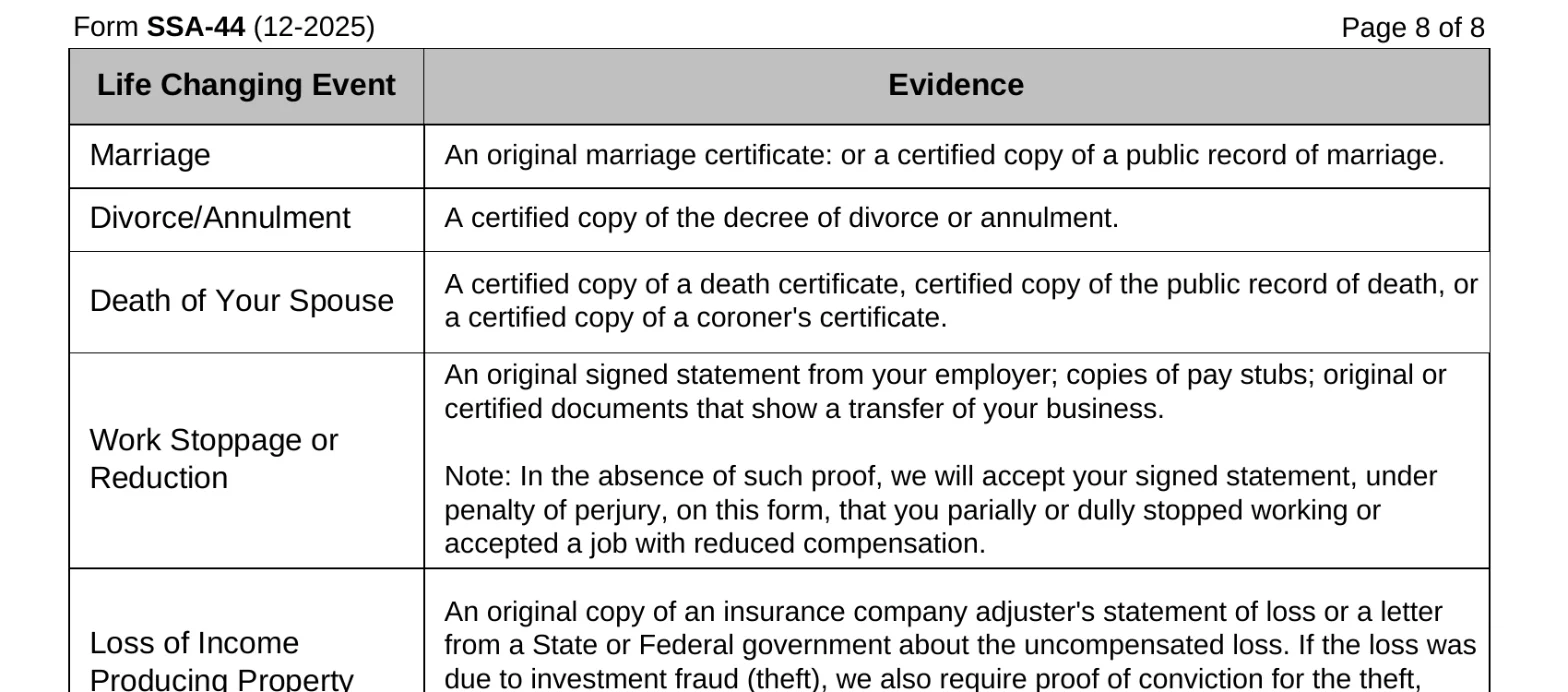
Short answer: Evidence that clearly documents the stop or cut in work: a signed employer statement, a retirement letter, pay stubs, or business sale or transfer records. Without these, Social Security accepts your signed statement under penalty of perjury on the form (Form SSA-44; POMS HI 01120.030; 20 CFR 418.1255(d)).
Evidence of the event
One item that clearly documents the event is generally enough.
- An original signed statement from your employer showing when you stopped or reduced work
- A retirement letter
- Pay stubs; for a reduction, before-and-after stubs showing the change in hours (POMS HI 01120.025)
- If self-employed: records of the sale or transfer of your business, or corporate minutes
- If you have none of these: your signed statement on the form
Evidence of income
- If you've filed the return for the Step 2 year: a signed copy or an IRS transcript. If you e-filed, print and sign a copy (POMS HI 01120.030).
- If you're estimating: the MAGI estimate the form asks for in Step 2 (and Step 3, if it applies), confirmed by your signature in Step 5. Social Security will later ask for a signed copy of the return once it's filed (SSA-44 instructions; 20 CFR 418.1265)
Helpful for your estimate, not required
- Your IRMAA notice, plus the return Social Security used and your most recent return
- Year-to-date Forms 1099-R, brokerage and pension statements, and your final pay stub or W-2
- A list of IRA withdrawals, RMDs, Roth conversions, or asset sales planned for the year
How do you submit SSA-44?
Short answer: Upload it after signing in to my Social Security, fax or mail it with your evidence to your local Social Security office, bring it to an appointment, or call 1-800-772-1213 (TTY 1-800-325-0778) and say you want to lower your IRMAA because of a life-changing event (SSA: Request to lower IRMAA).
The full process, from notice to decision
1. Read your notice. Note the tax year used, the MAGI Social Security received, your filing status, your IRMAA amounts, and the notice date. 2. Check the figures against your return (line 11 plus line 2a). A mismatch is a data problem, not an SSA-44 problem. 3. Confirm the event and its month and year. 4.
Pick the Step 2 year and make a good-faith MAGI estimate. 5. Check the estimate against the brackets. If it doesn't reach a lower bracket, filing won't change that year's premium. 6. Gather your evidence. 7. Complete the current SSA-44, one per spouse paying IRMAA. 8. Submit it by one of the routes above. Keep copies and note the date.
To cover this year's premiums, make the request this year. 9. Answer evidence requests within 30 days, or ask for more time (POMS HI 01120.001). 10. Follow through. Send a signed copy of your return once you file it, and check which income next year's notice uses.
What happens after Social Security reviews your request?
The review. A field office or processing center handles the request. Missing evidence can be marked pending while you supply it; if it never arrives, the request is dismissed (POMS HI 01120.001). Neither the form nor Social Security's IRMAA request page lists a processing time, so call if you haven't heard after several weeks.
The decision. You'll get a notice. A favorable decision is generally effective January 1 of the year you made the request, or the first month of your Part B or Part D coverage that year if it started later (20 CFR 418.1230; POMS HI 01120.005).
Can SSA-44 refund IRMAA you already paid?
Short answer: Yes, for the period the new determination covers. The original amount keeps being charged until the decision; then Social Security refunds the excess retroactively (POMS HI 01101.050). If your premiums come out of your Social Security benefit, the deduction changes there. If you pay Medicare directly, Social Security notifies CMS, which handles the adjustment (POMS HI 01130.035).
Later, when the IRS has the return for the year you estimated, Social Security compares the two. Same bracket, no change. A lower bracket means a refund. A higher bracket triggers a notice of the planned change; if you don't respond within 20 days, Social Security sends a correction notice and collects the difference (POMS HI 01130.035).
Deadlines: what's fixed and what isn't
| Rule | Meaning |
|---|---|
| SSA-44 filing deadline | None fixed after event/MAGI drop (POMS HI 01120.005) |
| Effective date | Generally January 1 of request year or first coverage month (20 CFR 418.1230(a)) |
| Prior premium year | October–December event, request by March 31 next year, or good cause (20 CFR 418.1310) |
| Drop next year | January 1 next year (20 CFR 418.1230(c)) |
| Reconsideration | 60 days after receipt, presumed five days after notice date (HI 01140.001) |
| Missing evidence | 30 days; possible 90-day extension (HI 01120.001) |
If you disagree, or the request is dismissed
A new determination carries appeal rights: reconsideration on SSA-561-U2 within 60 days, reviewed by someone other than the original decision-maker, then a hearing before an administrative law judge at the HHS Office of Medicare Hearings and Appeals, the Medicare Appeals Council, and federal court
(POMS HI 01140.001). A dismissal, such as when evidence never arrives, can't itself be appealed. You can refile with the evidence, and the dismissal may give you good cause for a late reconsideration of the original decision (POMS HI 01140.005).
When SSA-44 is not the right route
Short answer: When nothing on Social Security's list of events caused your MAGI to fall. The list is exclusive. Events that affect only your expenses, and losses from the ordinary risk of investment, don't qualify (20 CFR 418.1210; 418.1205(e)). Three questions get blurred: does it change MAGI, can it cause IRMAA, and is it a life-changing event?
| Situation | Changes MAGI? | Can cause IRMAA? | Life-changing event? |
|---|---|---|---|
| Retirement | Yes: removes wages | No | Yes: work stoppage |
| Roth conversion | Yes: raises it | Yes | No |
| Sell stock/home/property at gain | Yes: taxable gain | Yes | No |
| Voluntary rental-property sale | Yes; rental income ends | Yes in large-gain year | No |
| Loss to disaster, arson, fraud/theft with conviction | Yes | No | Yes: income-producing property loss |
| Pension terminated/reorganized; benefits cut | Yes | No | Yes: pension income loss |
| Dividends shrink | Yes, slightly | No | No |
| Portfolio market value drops | Not by itself; realized gains/losses affect return | No | No |
| Medical/living expenses rise | No | No | No |
| Start RMDs | Yes: raises it | Yes | No |
Sources: 20 CFR 418.1205, 418.1210, and POMS HI 01120.005. Whatever raised your MAGI, whether a conversion, a gain, or a sale, is almost never what qualifies you. What qualifies is a change in your life; for retirees, the job ending. (Filed married filing separately but lived apart all year? SSA-44 says to call Social Security instead.)
Edge cases that change the answer
You retired late in the year A December 2025 retiree's 2025 return still holds nearly a full year of pay, so use a 2026 estimate. The October-to-December rule in the deadlines table can reach back to the event year, but only helps if that year's MAGI is low enough to change your bracket (20 CFR 418.1310).
Your spouse still works On a joint return, your spouse's salary stays in the MAGI compared with the joint brackets, so relief may be partial (Retiree C). When your spouse later stops working, that's a new work stoppage for you, and you can file again (POMS HI 01120.030).
Only one of you is on Medicare Only the person paying IRMAA files, and a request never carries over to the other spouse (POMS HI 01120.001). When the second spouse enrolls, they get their own determination and may need their own request. Your income falls further next year Use Step 3. The clearest case is retiring partway through the premium year.
Your estimate turns out different Update it as often as needed; otherwise the later IRS check settles the difference. An update can't push IRMAA above the level originally set from IRS data (POMS HI 01120.065). You sold or handed off a business Sale or transfer records prove the work stoppage.
The gain itself is non-qualifying one-time income that counts in MAGI for the year of the sale, so the year after the sale may be the one that shows the drop (POMS HI 01120.005).
You retired years ago, and IRMAA came from something else Retired in 2019, with 2026 IRMAA from a 2024 Roth conversion or home sale? The drop comes from one-time income ending, not from retiring, so SSA-44 isn't the tool. The surcharge is tied to the premium year that uses that return. You had more than one event Check every event that applies in Step 1 and give the dates.
Common SSA-44 mistakes
1. Entering a Step 2 year that isn't newer than the one on your notice, or a late retirement year that still holds most of a salary. 2. Using taxable income, or AGI without line 2a. 3. Treating "no paycheck" as "no income." IRA withdrawals, gains, the taxable part of Social Security, and final payouts all count. 4. Assuming one form covers both spouses. 5.
Waiting until next year to seek relief for this year's premiums. 6. Missing the 30-day window for requested evidence. 7. Skipping the follow-through: the signed return once filed, and an updated estimate if it changes. 8. Working from an older edition of the form, or using SSA-44 for wrong IRS data, an amended return, or a miscalculation.
Frequently asked questions
Is Form SSA-44 actually an appeal? No. It's a request for a new initial determination using more recent income. The formal appeal is reconsideration on SSA-561-U2; the route table near the top shows which fits your situation. Does retirement automatically lower IRMAA? No. Retirement qualifies as the event, but your newer MAGI must drop enough to lower or eliminate IRMAA (20 CFR 418.1201).
Is there a deadline for SSA-44? There's no fixed filing deadline, but relief generally starts January 1 of the year you make the request. See the deadlines table above. Can I submit SSA-44 online? Yes. Sign in through Social Security's Request to lower IRMAA page to fill out and upload it. Can my spouse's retirement qualify as a life-changing event? Yes.
The rule covers "you or your spouse" stopping work or reducing hours (20 CFR 418.1205(d)).
Will I get back IRMAA I already paid? If the decision is favorable, Social Security refunds the excess for the period it covers, generally from January 1 of the year you made the request (POMS HI 01101.050). Do both spouses need separate requests? Yes, if both pay IRMAA. Each request applies only to the person who files it, even with a joint return.
What happens if my income estimate changes? Tell Social Security. It may make a new determination and adjust that year's premiums retroactively (20 CFR 418.1245). Can a Roth conversion qualify for SSA-44? No. Social Security lists IRA conversions as non-qualifying one-time income (POMS HI 01120.005).
Your next step
Find the tax year on your IRMAA notice, then estimate MAGI for the year you'd put in Step 2, counting everything that replaced your salary. Next, check whether that estimate actually lands in a lower bracket. If it does, gather proof of your work stoppage and submit SSA-44 through Social Security; to cover this year's premiums, make the request this year.
If it doesn't, filing won't change this year's premium, and the useful question becomes when the lookback catches up with your retirement.
Before you submit SSA-44, check your numbers
If retirement or reduced hours lowered your income, the question left is whether your newer MAGI actually moves you into a lower IRMAA bracket. CheckIRMAA helps you work through that before you hand your estimate to Social Security.
Use the result to understand your numbers, then follow Social Security's official process for any SSA-44 request: the Form SSA-44 PDF or the online Request to lower IRMAA page. If a business sale, large capital gains, or a Roth conversion overlaps your retirement years, a CPA can help you build an estimate you can defend.
For questions about which year to use, the form's instructions say to call Social Security. This guide explains federal rules in general terms. It isn't individualized tax, legal, or financial advice, and it can't predict how Social Security will decide your request.
Sources
Federal regulations: 20 CFR Part 418, Subpart B, with corresponding Part D provisions in Subpart C
- § 418.1201: when a more recent tax year is used
- § 418.1205: what is a major life-changing event
- § 418.1210: what is not a major life-changing event
- § 418.1215: what is a significant reduction in income
- § 418.1225: which more recent tax year is used
- § 418.1230: effective dates
- § 418.1235: when Social Security stops using the more recent year
- § 418.1245: changes to your more recent year's MAGI
- § 418.1255: evidence of the life-changing event
- § 418.1265: evidence of the MAGI reduction
- § 418.1310: requesting a new initial determination
Social Security Administration
- Form SSA-44, Medicare Income-Related Monthly Adjustment Amount – Life-Changing Event (12-2025), including instructions
- Request to lower an Income-Related Monthly Adjustment Amount (IRMAA)
- POMS HI 01101.010 (MAGI), HI 01101.050 (questions about a determination), HI 01120.001 (new initial determinations), HI 01120.005 (life-changing events), HI 01120.025 (work reduction), HI 01120.030 (work stoppage), HI 01120.065 (revised estimates), HI 01130.035 (annual verification), HI 01140.001 (appeals overview), HI 01140.005 (reconsideration)
CMS and Medicare
- 2026 Medicare Parts A & B Premiums and Deductibles
- Medicare.gov: Costs
IRS
- 2025 Form 1040
- Publication 6142, Additional Deduction for Seniors
- Roth IRAs